
Roasted in Plymouth, MA

 ↓ Our Coffees
Roasted in Plymouth, MA
↓ Our Coffees

A lighter roast of Costa Rican Arabica beans. Grown at high altitude, this coffee is bright, fruity, and complex, without being sour.

An all-day medium roast of Honduran beans - balanced, clean, and endlessly drinkable.

Our favorite blend of medium and dark roasted Guatemalan beans. Chocolate, caramel, and comfort in every cup.
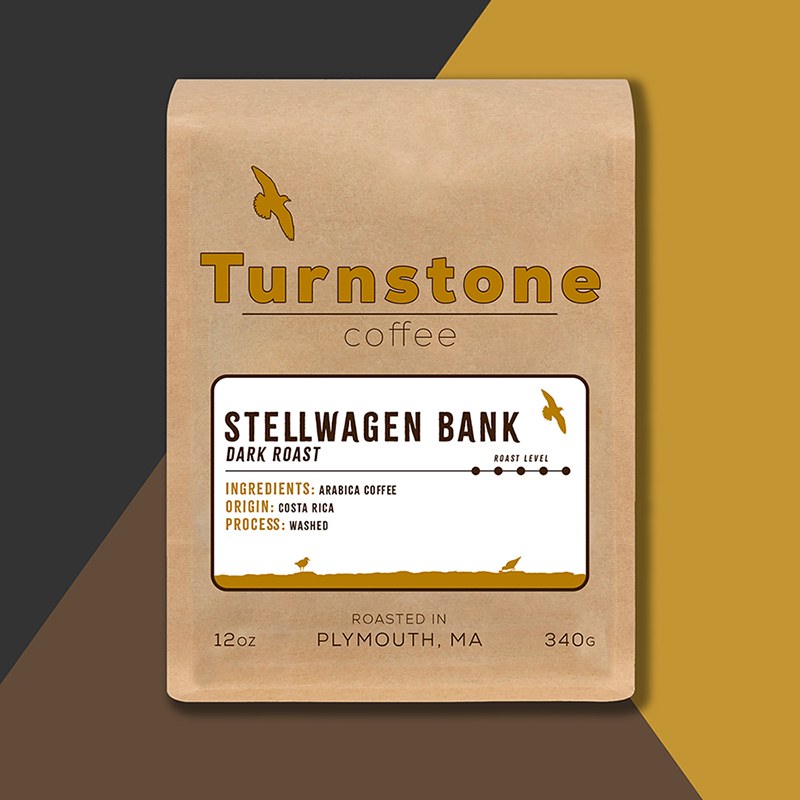
Very dark, very mysterious. Dark chocolate, roasted nuts, and earthiness.

A medium/dark roast of a seasonally selected coffee. Rare, amazing, and special.
Ethically sourced beans from around the world, roasted in small batches near the shore in Plymouth, Massachusetts.
We believe coffee should be carefully crafted, consciously sourced, and cheerfully consumed. Turnstone is a no-judgement zone. Your grind and your brewing style are your business. Our beans work well any way you want to brew them.
Just coffee, made with care, near a shore where the birds are always working.
Every bag of Turnstone Coffee carries the name of one of the most determined little birds on the planet — a short-legged, orange-footed shorebird that has spent millions of years perfecting the art of leaving no stone unturned. Arenaria interpres · Ruddy Turnstone
It does exactly what it says on the tin. The Ruddy Turnstone wedges its short, slightly upturned bill under rocks, shells, clumps of seaweed, and whatever else the tide has left behind — then flips. What's underneath? Usually something worth eating. Crustaceans, mollusks, sand hoppers, worms. The bird has no interest in what something looks like on the surface. It wants to know what's underneath. We respect that philosophy.
Ornithologists have catalogued six distinct foraging techniques used by turnstones: routing through seaweed by bulldozing and flicking, flipping individual stones, digging small holes with quick bill-jabs, probing into crevices, surface-pecking for exposed prey, and — when a rock is simply too big to move alone — recruiting other birds to flip it together. They are collaborative when the situation demands it.
In breeding plumage, the Ruddy Turnstone looks like it lost a bet and won the bet at the same time: bold black-and-white face, chestnut-orange back, bright orange legs. Cornell Lab describes it as looking like a calico cat. In flight, white stripes blaze down the wings and back. It is, by any measure, an extremely well-dressed small bird. Outside of breeding season it tones it down to brown — but keeps the orange legs, because some things are non-negotiable.
The Ruddy Turnstone nests on high Arctic tundra — just a few kilometers from the sea, usually. Come late summer, it heads out. Birds have been recorded flying over 1,000 kilometers in a single day during migration. They winter on rocky shorelines and sandy beaches across six continents, from Cape Cod to Cape Town, from Iceland to New Zealand. Some Alaskan birds take entirely different routes in spring versus fall, cutting across open Pacific Ocean on the return trip. It is a serious traveler.
For all that wandering, turnstones are intensely faithful to the specific stretches of coastline they choose. A 2009 study found that 95% of birds wintering along a stretch of the Firth of Clyde in Scotland returned to the exact same spot the following autumn. They know their beach. They know their rocks. They come back every year to the same tide line and start flipping. There's something to be said for that kind of loyalty to a place.
Carl Linnaeus formally described the species in 1758, assigning it the epithet interpres — Latin for "interpreter" or "messenger." The genus name Arenaria means "inhabits the sand." In Hawaii, it's called akekeke, an onomatopoeia for its rapid staccato call. Average lifespan is around nine years; the record holder made it to twenty. Annual adult mortality runs under 15% — making the Ruddy Turnstone one of the longest-lived shorebird species known. Small, tough, and built to last. Not a bad thing to name a coffee after.